Showing posts with label advice. Show all posts

Wednesday, 5 March 2014

mindmap: manageable megadungeon


I blame Greyhawk Grognard of course.  There was a lot of words.  I mean a lot of words.

Then I decided this may be a shade ironic given this was about making megadungeons manageable.

So I thought... mindmap?  Plus I had to give XMind 2013 a spin.

This reminded me just how much good stuff is out in the blogosphere. So for your viewing pleasure...

Mindmap: Manageable Megadungeon (PDF).
Or if you prefer, XMind 2013.

There are numerous lists out there (some included) but keeping track of it all is a challenge.  For those less able to speed-read, this may be some help.  Please provide feedback in the usual location!

Monday, 3 February 2014

28 days later - D&D's 40th bloghop (abridged version)

Marathon blog carnivals to commemorate D&D's 40th birthday is a thing it seems.  Like the blog carnival idea. Unsure on 28 days of grognard nostalgia.  Especially as the first question ends with 'Tell Me About Your Character'.  Dyson has a point, participation without zombie mode wins.

Please feel free to use the logo opposite if you want to dig in without going the full 28 days.  Especially if you have plans for Valentine's Day that don't involve posting how you dress up in wizard's robes for your significant other. Some stuff is best left unsaid.


.
1. Who introduced you to D&D?  Which edition?  Your first character?
Leslie Ash, I kid you not. Hanging around my gran's watching Pebble Mill (proto-formulaic daytime TV) while off with flu.  This was the 1980s. Wander back from kitchen to see Leslie playing a chaotic elf fighting a skeleton in a room filling with water. Got the Moldvay Red Box soon after Created a fighter called Ironhawk, gave him chainmail, a halberd and adventurer's pack and... ended up being the DM anyway.  So it goes.

2. Who you first introduced to D&D?  Which edition?. Their first character?
My cousin, Craig, a week after I got the Red Box.  His character was a fighter with a battleaxe and shield whose name is lost to antiquity.
He discovered girls the following week so the game folded shortly after. There's something oddly symmetrical about that.

3. First dungeon you explored as a player-character or ran as a DM?
Home brewed, took stuff from Keep On the Borderlands, added in bits of Earthsea (chunks of the Tombs of Atuan) and The Hobbit.  Kept the Pebble Mill water trap with skeleton.  You don't mess with good ideas when starting out.

4. First dragon your character slew.
A young black dragon who woke up surrounded by a very nervous party.  It's dying memory was a halberd in the eye.  And that was the upper limit of 3rd level for Ironhawk for over a year...

5. First character to go from 1st edition to the highest level possible in a given edition.
Ironhawk got to 3rd level and loitered there awhile because D&D Expert set didn't hit our FLGS for months.  Meanwhile, brief flirtations with Gamma World, Traveller, Runequest 2nd ed and something called Advanced Dungeons & Dragons were afoot.  We found most players were driven off by the maths and most DMs by coming up with challenges by about 14th level.  Giants/Drow/Lolth was popular for a time as were adaptations of D&D Companion modules for AD&D and DragonLance.  The real forays into 1st - 20th didn't happen until 3.5E and a dedicated campaign based on Morrowind lead to Raziel, a half-drow rogue/assassin/shadowdancer and his allies taking on that world's tarrasque and winning.

6. First character death?  How did you handle it?
Traveller.  Never bring cloth armour and SMG to a laser carbine firefight.  Phillip, the GM saw I was less than enthused at the result.  We were all precocious gamer kids. Rest of party regrouped after medical attention, I rolled up a new PC and we kicked ass with explosives.  Healthy respect for laser weaponry since. :)

7. First D&D product I ever bought.  Do I still have it?
A much-battered Red Box.  The only physical evidence I have of it is the battered blue d8.  Everything else was dismembered by over-use or went AWOL down the years and house moves.  I do have a pocket-sized Red Box book instead now.

8. First set of polyhedral dice you owned. Do you still use them?
See question 7.  I have an eclectic collection of dice, as over the years, complete sets become incomplete. Sharing houses with cats and gamers does that to you.

9. First campaign setting (published or homebrewed) that you played in.
D&D's Known World (though it wasn't at the time) and World of Greyhawk tie on this one.  Two separate games - started at the same time.

You never forget your first...
10. First gaming magazine you ever bought.
Dragon #73.  Closely followed by White Dwarf #35.  Having recently sent a number of mistreated Dragons (no covers) to the fire, it amazed me how much of this stuff I've kept around over the years.

11. First splatbook I begged my DM to approve.
Hmmm.  When the whole splatbook thing started to become a thing for us was the Complete… books.  You could usually spot good ideas from the bad but didn't have an entire book you'd argue for.

12. First store where you bought your gaming supplies.  Does it still exist?
Games Centre in Broadmarsh.  Lasted about 3 years, then moved, then got bought by a then-growing company by the name of Games Workshop.  You may be aware of their work?

13. First miniature(s) you used for D&D
Apart from a brief flirtation with Grenadier figures back in the beginning, the figures thing didn't really take off until much later.  I have some figures, some painted, some less so.

14. Did you meet your significant other while playing D&D? Does he or she still play?
Yes and yes.  Opportunities are sparse but it still makes me smile we occasionally spend quality time by being other people.  The last D&D game we played in together, she was a half-elven spy sorceror/rogue. Parenthood has made getting time to game tricky but plans are afoot.

15. Which was the first edition of D&D you didn't enjoy? Why?
Would you believe 3rd edition?  Remove abstraction, add in attacks of opportunity AND reheat leftovers. Owning three different versions of the Axe of The Dwarven Lords, yeah, not so much.  That said, I like 3.5 and Pathfinder is my current poison.  The best thing about this was it encouraged me to go further afield.

16. Did you remember your first Edition War.  Did you win?
Yes I do.  A heated and at times, alcohol-fueled debate on the merits of 1E vs lovingly crafted homebrew system played by friends.  Nobody wins edition wars.  George Barnard Shaw's aphorism about wrestling pigs applies here.

17. First time you heard that D&D was somehow "evil".
Rona Jaffe's Mazes & Monsters lit the fuse for about a year of 'Satanic panic' which then fizzled in the face of other concerns like heavy drinking and 'the wrong crowd'.  Honestly, you just can't please some people…

18. First gaming convention you ever attended.
Beer & Pretzels was my first and that was fun.  That said, I understand organising events is tricky. Watching recent industry flailings at equality is painful.  Makes you want to do better.

19. First gamer who just annoyed the hell out of you.
Nobody's annoyed me on a molecular level at a D&D game.  Usually to annoy the hell out of me, you need to know me outside the game.  That said, I'm a believer in The Angry DM's view of cowardly characters.
My opinion of pacifist characters is uninformed, I've never seen one played longer than one session.

Or your second... 
20. First non-D&D RPG you played.
Traveller.  Minimalist, computer manualesque books in None So Black covers. First exposure to character death during generation.  Also first character death. White Dwarf made an art form of Traveller scenarios back in the day.

21. First time you sold some of your D&D books - for whatever reason.
About five years ago, I actually sold off some stuff on Ebay as we needed the space.  Prior to that, we gave our books to friends, figuring they'd get re-use and the book would get a good home.  I've found charity shops can be a little unpredictable about donations of this kind.

22. First D&D-based novel you ever read.
The first Dragonlance novel.  You could see the mechanics, the creaky characterisation.  For all it's flaws, influential among gamers.  I understand the form has moved on a bit.

23. First song that comes to mind that you associate with D&D.
Killer of Giants by Ozzy Osbourne from The Ultimate Sin.  The group I ran Giants/Drow/Lolth for used it to get into the zone and every time I hear anything from that album it brings back a wry smile.

Your tour guides to the
scenic Temple of Set
24. First movie that comes to mind that you associate with D&D? Why?
Conan The Barbarian.  Closely pursued by the Sinbad movies and Jason & The Argonauts.  There are also numerous '80s sword & sorcery flicks who have a lot to answer for.

25. Longest running campaign / group you've been in.
D&D - One group.  Membership rotates, 9-ish campaigns over 20 years with numerous one-shots/short bursts, the next generation is on it's way.

26. Do you still game with the group that introduced you to the hobby?  
Nope, people move on and move away.  It's part of life's rich tapestry.

27. If you had to do it all over again, would you do anything different when you first started gaming?
Obviously yes, hindsight is wonderful.  Finding a more organised game scene earlier would have cleared up some early confusion.  Folks these days have it much easier.

28. What's the single most important lesson you've learned from playing D&D?
Lateral thinking gets you far but not all the way.

Monday, 15 July 2013

Into the tridimensionalplaneboxmegacrawlathonsandhexamagig

Over at Monsters & Manuals, meet the Tri-dimensional Planebox Megacrawlathon SandhexamagigTM!  The simplified premise - take one hex map.  Copy it three times.  Assign each a different genre and populate according to genre.  Irradiated post-apocalyptic badlands become burning desert wastes, fortified dragon lairs become starports.  Flip or mirror-image building maps.  Provide strange methods of moving between.

Black ziggurats, eerie ships, forgotten gates, strange artifacts, multidimensional tunnels or shantak rides are fair game.  Recycle certain NPCs but with a twist.  A loyal soldier in one is a serial killer in another.  The old werewolf miner with a limp becomes a wolfoid silt pirate on crutches.  And so it goes. Then run the whole glorious mess, moving between settings as game circumstance and group whim demands.

Allowing for bleedover gives spice.  It allows for things like:

Among the encounters for each setting, sprinkle in oddities according to taste and availability of tranference mechanisms.  If you're atop a 'hellmouth' spewing postapocalyptic mutants, this'll skew demographics - you might also consider moving.  Locals will react to anomalous phenomena.  Some build walls, others build inns - a few may forge empires built on the mechanism.

One thing's for sure.  You'll never be short of material.

Friday, 8 February 2013

anatomy of an apocalypse - part 2

In part 1, we left things after a series of surgical nuclear strikes and civilisation reeling from ten years of nuclear winter.  Millions died in nuclear fire, millions more from fallout.  Famine claims the greatest number of victims.  Most supermarkets last nine days before food runs out in conventional situations (extreme weather or fuel shortage).  Panic buying is not uncommon.  Extreme situations yield food riots, laws against hoarding, rationing and military support of law-enforcement. Most survivalist food plans expire in five years, halfway into the decade without summer.

When the food ran out...
 
...all hell broke loose.  Rioting met brutal responses from armed police with military support able to fight a recognisable threat.  The more powerful civic leaders and military commissioned research regarding creation and preservation of food. Production was a top priority.  Farms had to meet intensive quotas.  Heavily guarded bio-domes and hydroponic warehouses use sunlamps to grow through the dark seasons.  This isn't the only option.  Evidence of cannibal communities is hidden by horrified civic leaders. 

Symptoms of kuru and amyloidosis are identified by medics.  Despite all the death, too many mouths need feeding.  Secretive purges of individual serial cannibals and growing cannibal gangs are led by pro-establishment brainers. Yet cannibalism appears in cities and rural communities. Food caches of MREs and freeze-dried goods are treasured secrets, used only in dire need.  Shifts from increasingly scarce food stores to sustainable food supplies means tightening belts.  Horror stories of cannibal cults led by charismatic leaders become more prevalent.  Society begins a slow-motion splintering.

Listen to the voices... 

The psychic maelstrom is a product of the millions of dead.  Yet pandemics claim equivalent body counts without forming a worldwide miasma of psychic energy.  And if they do, they're rarely as informative as this one.  So why are the dead so damned helpful?  Consider the gutting of a worldwide infrastructure due to the Cull's EMP and burning cities out.  Surviving engineers are kept busy.  Some rebuilding occurs and there is nothing like necessity to breed invention.

Satellites require significant investment and connectivity breaks.  Nanoscale networking is a different approach and worldwide production nodes may reconnect people.  Imagine a communicable personal nano-network linking you to the Internet.  Pre-Cull brainer tech like implant syringes or violation gloves (amplifying signal or rapid processing) makes this less of a leap.  The resulting noosphere mixed ingenuity and horror in the last two years of the Decade Without Summer.  Cryogenic stasis became a reality. Leaders of men and entourages enter bunkers to sleep away their troubles until the land is renewed again.

Introducing... the Burn.

So what stops satellite-assisted human ingenuity and the nanoscale Internet?  Irony demands a solar event. 2012 saw increased awareness of coronal mass ejection.  CME events reach peaks every 11 years. Heralded by solar flares, powerful CME events weave auroral displays, burn out satellites, disrupt electronic and power networks.  A global Carrington event electrifies power lines, phone lines and pipelines. Transformers blow, satellites burn out, electrified lines go down and fuel pipelines experience electrical fires.

Blackouts again and fewer engineers means longer downtime.  The noosphere dies and panic ensues again as electronic controls fail.  Eventually the nanoscale network reboots.  Things are different, inexplicable sensory impressions, voices whispering.  This glitch births the psychic maelstrom and over forty years, it transcends it's original form.   The gifted and strange attune to it.  Information is lost, corrupted or transformed into formats man was not meant to know.  Insanity spikes among noosphere users, what seemed salvation is risky.  Those with latent psychic ability become gifted.  Nobody knows how or why.

Colony collapse disorder

In the wake of The Burn, civilisation finally splinters.  Famine rears it's ugly head as the farms lose power.   This time, mere anarchy prevails.  Authorities retreat or are overthrown.  Holdings form at power stations, factories, hospitals and military bases.  Mirroring declines in bee population, people abandon cities after looting them.  Those who remain carve out niches.  Cannibalism, insanity and mutation - the last from exposure to environment, radiation, pathogens or psychic maelstrom grows more prevalent.

Sustainable farming and hunter-gathering becomes the norm.  Communities disperse or form around working power sources.  The adoption of biogas from waste products and traded generators means cars can run and electrical light is possible.  Communities shrink out of necessity.  Trade in oil, petroleum and gas still occurs. Money becomes meaningless - barter now makes sense.  In time, skills are lost and memories of the world before the Cull are told to children. The omnipresent psychic maelstrom whispers equal education and confusion.  Things get a little scrambled in the re-telling.

In the absence of government or corporate interest, infrastructure decays.  Roads crack, sewer systems and flood defences are compromised.  Those with skills effect small-scale repairs. Larger problems are left to fester.  In addition, culture begins to erode.  Magazine celebrities become archetypes studied by manipulators.  Savants and operators ply their trades. Names lose meanings in the struggle to live - those who die are remembered and sometimes eaten. Fifty years after the bombs exploded, this world is bleak.

You are here.

Monday, 28 January 2013

anatomy of an apocalypse, part one

Apocalypse World.  Helluva game, as has been remarked by various people.  Having recently run a six-session game for new players, here are some setup experiences and points on the learning curve from the group (myself included).  I prefer recaps and summaries to actual play reports, some play decisions will creep in here as they reflect learning points.  The nature of the apocalypse is open-ended and this is one of the first decisions an MC needs to consider.

The rules imply certain common elements.  It's fifty or so years after the event.  Burned-out cities, a night sky of murky twilight, scarce food and water, fear and ignorance as the norm.   Society is broken down gangs cleave to personalities or holdings.  No Internet, working electronics are precious, bullets and fuel are still plentiful.  Cultural identity is annihilated, names have lost meaning.  In the ruins gifted individuals survive and bond.  The psychic maelstrom whispers secrets and lies to the strange and desperate.  High technology enhances psychic abilities yet little working infrastructure remains.

Choose your own damn catastrophe

The book refers to burn-flats, suggesting to me nuclear exchange.  You may prefer asteroid strikes, runaway virus, esoteric rapture or alien invasion.  Knowing how things got so bad means backtracking to identify the nature of the catastrophe.  The vast majority of characters won't have been around when it happened.  And if someone wants to play a grizzled bad ass, one question you must ask is "How did you escape the apocalypse?"  Open questions are key to a good game.

The footprints of the disaster are useful.  They help identify threats, give context to fronts and flavour for moves against the player characters.  Crossing a burn-flat, irradiated water, decontamination rituals by cultists and packs of mutants are fair game.  Fleshing everything out isn't desirable but a cheat sheet of ideas will help with session prep.  As MC, you'll have questions to answer yourself.  In the first session (and after), players will provide plenty of ideas.  Incorporating them into the game makes for a better game and gives them investment into the game too.

Deciding what the hell happened. 

I thought about The World Before.  Like our world but with brainers armed with high-tech - a setting worth investigation.  With the number of cities and megacities, the body count would be immense, a cull of humanity.  Research on this topic and sites mapping a nuclear explosion on Google Maps gives you a point of reference.  To reduce the population to those levels might need a nuke in every city with a population over, say, 1 million... roughly 500 cities.  So where do you find 500 nukes?  Not as hard as it sounds.

A simultaneous nuclear strike in every major city would shake the pillars of civilisation without worldwide annihilation of life.  These surgical strikes would prevent other nations taking control until nuclear winter sets in. The initial destruction and the following consequences are sobering reading.  Reading around the TTAPS study and supplementary research, I chose 340 kiloton devices.  Seeing the words cull of humanity in my notes, suddenly a conspiracy trying to control world population who get it horribly wrong appears - motive and method.  Now to work out the opportunity and events from The World Before to The World After...

Introducing The Cull

On the 5th November, 500 simultaneous nuclear strikes rip out the heart of every major city.  Millions die instantly, world stock markets shatter with telecoms and media hubs gutted by EMP, firestorms and gamma radiation.  Plumes of smoke, irradiated dust and carbon are borne aloft.  Some falls as black rain.  Some enters the stratosphere, sowing seeds of nuclear winter.  Fallout scourges metropolitan areas and nearby cities driven by prevailing weather.  Civic infrastructure screams, buckles and shatters.

Civilian complacency is rewarded by rolling blackouts and hastily-invoked contingencies.  Those who can flee, those who can't either barricade themselves in or riot in the streets.  Governments reassert control despite collapsed markets, catastrophic damage to population centers and crippled infrastructure.  Rural communities face a 'golden horde' of looters and refugees, military units are mobilised to keep order.  In some countries, martial law is imposed.  In others there is insurrection.  Political instability, aggressive stockpiling and public dissent increases.

A manifesto is released via multiple channels, justifying the strikes as preventing an overpopulation crisis.
The conspiracy is swiftly hunted down and dismantled.  Interrogation combining conventional and psychic means reveal extensive conditioning.  Copies are adopted by fanatics and demagogues.  As the month comes to an end, radiation poisoning claims more lives.  Economic negotiations are convened and fail to rebuild the markets desperately needed to supply food to the cities.

The Decade Without Summer

Then winter bites down hard.  Stratospheric dust opaque to infra-red but not harmful ultraviolet radiation shades the Earth from sunlight.  With targets near the equator, both Northern and Southern hemispheres experience chilling weather, spoiling harvests.  Black snow and ice storms wreak havoc.  The Northern hemisphere loses sunlight through the first winter, the Southern hemisphere has overcast days with searing ultraviolet light which blinds and burns unprotected animals and humans alike.

Multiple bombs detonated in Brazil, Africa and South East Asia punch holes in the ozone layer and chill the oceans further.  Hemispheric separation of wind currents means the Northern hemisphere bears the brunt of the winter.  Spring, such as it is, is worse.  Ozone depletion increases due to reflected sunlight heating stratospheric nitrates.  Agriculture is decimated, lack of sunlight and cooler temperatures leads to widespread famine.  Deaths follow after, stories of food riots and cannibalism are suppressed by remaining governments.  The next five years, global rainfall decreases by 10%.  The winter lasts for ten long years.

After a decade, enough dust has fallen out the sky for the worst to dissipate.  Lasting temperature drops of a few degrees centigrade worldwide remain by the time the players play.  The ozone layer is damaged so UV exposure is a threat.  Food and water are scarce now and millions have died of famine.  We have another forty years to work out.  Questions about the psychic maelstrom, whether civilisation would survive the decade without summer, how things got from here to The World After still remain...

Tuesday, 15 January 2013

food as set dressing

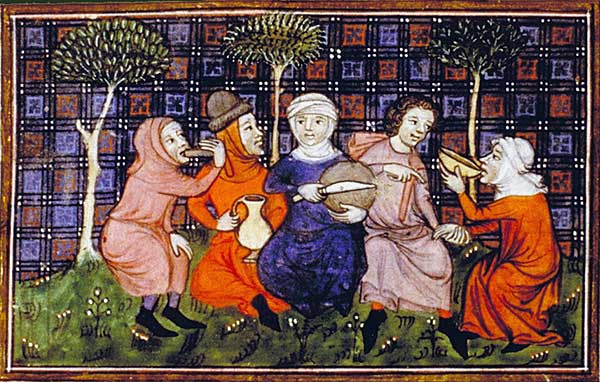
Peasants breaking bread (Wikimedia)
Over at Cirsova, a food and fantasy blog carnival runs until the 21st. Food can evoke emotion and conjure sense memory.  Responses to those emotions and sense memories are typically visceral. Dietary habits for people are primarily beholden to environment and agriculture.  Culture and religion may shape this further.  There are other factors involved of course.
  • Exploration, conquest and trade may introduce new food.
    The popularity of garum (a pungent sauce made of rotted saltfish) among the Greeks, Romans and the Byzantines enabled trade across the Mediterranean and as far as Roman Britain.  The New World brought potatoes and tomatoes to Europe.  Chocolate (chocolatl) was another export that found favour with the Spanish.  Wars have been fought over salt and pepper inspired epic exploration.
  • Immigrant populations may bring their own foods and spices. 
    The popularity of curry in Britain, or variations in Minnesota lutefisk follows immigrant influence; if your game has an invading population or a neighbouring culture, their food and drink influences yours. Elven baklava may be served with coffee and a pipeweed hookah in a free port tavern where halflings and elves have neighbourhoods in a Moorish-based settlement.
  • Wealth and status brings a better class of food - usually.
    Access to certain ingredients (salt) and spices may require wealth.  Peasant staples are transformed by quality of ingredients.  Breads may have finer flour or more wheat.  Now add to this other dishes.  Laws mark foods (rabbit or venison) as noble perogatives.  Roasted meat means fresh good-quality meat, more likely noble fare.  Some noble delicacies however, are less than desirable.
In some settings, there is sufficient civilisation to ensure fine fare.  Courtly food may be about theatrics as much as taste.  Serving swan to royalty is mostly ostentation.  A high-fantasy equivalent may serve dressed cockatrice to nobles.  Magical augmentation of the meal is another option.  These combinations create meals worthy of fairytale.  A truly imaginative chef may have opportunities for extraplanar travel.

Other locations may have limited opportunities for the gourmet adventurer.  The dungeon expands culinary horizons out of necessity.  Roasted cave fish, select mushrooms and dwarven spirit may keep you happy (and off iron rations) for a little while until the wood runs out.  In the deeper underworld, your host might serve chilled goblin brains served in a trephinated skull.  Similar perils face those in desolate wilderness.  Arctic glaciers and burning deserts are not plentiful larders and eating sentients is an occupational hazard.

The discovery of exotic foods and drinks made fortunes.  Enterprising adventurers may find themselves in wars over spices.  If they inspired Marco Polo and Vasco de Gama to cross half the world, your lot might go some distance.  Royal charters, trading company monopolies, dragons with alternative hoards - all can provide unique adventures for characters. 

Wednesday, 16 November 2011

yet more tools for writing & groups


A trio of sites that help get ideas together.  What happens next?  That's down to you.

Springpad - This intuitive notepad app has hidden depths.  Idea capture, task management and integration with Google and Facebook.  Browser integration makes it easy to share notebooks or individual notes.  Web page capture is available.  Also supported on Android and iPhone.

TitanPad -  Fans of EtherPad may find this open-source web-based version useful.  The big draw here is that you don't need to install anything or sign-up to use it for short-term collaboration with up to 8 people.  Just open a pad and send a link - useful for editing around a document.  Doesn't play with Mac/iOS yet alas.  

Trello - A web-based virtual pinboard that lets you can ideas on boards and sequence them into 'to do', 'doing' and 'done'. Cards can be given attachments, colour coding, checklists, completion dates and voting options that can be expanded into a task management system including allocating cards to other Trello users.

Wednesday, 19 October 2011

upright men, honoured society and our thing

Maybe not Chaotic Good...
Over at Stuffer Shack, Tourq laments the presence of omniscent Thieves Guilds and their near-magical ability to demand a 'cut' from new arrivals in town.  While I was mildly skeptical about how the guild would work in his arguments, he has a point.  Thieves guilds get handwaved rather than being shown as a power. Also, there is a trend to romanticised, even Bowdlerised views of the Thieves' Guild.  While some games prefer a more low-fantasy view many guilds appear to exist as peripheral entities, taking money, sometimes dispensing missions or being a target.  They are anemic ciphers compared with, say, the Yakuza or Mafia.

Fictional guilds take a leaf from Fritz Leiber's 'Ill-Met in Lankhmar' and 'Thieves' House'.  Other trade guilds (locksmiths, masons, tailors) had stringent rules and protectionism - the model for Cervantes' Riconente and Cortadillo - a satire on guild stratification and nobility.  Dickens reveals the darker side of a gang in Oliver Twist.   When the truth outs about his unwitting involvement with pickpockets, Oliver barely enjoys liberty before being beaten and dragged back to Fagin's kitchen.  Ali Baba fears the Forty Thieves who object to his own theft by trying to kill him.  None of these behaviours are benign.

Medieval thieves' guilds weren't plentiful in reality.  Extended slum gangs like Cour des Miracles (inspiration for Hugo's The Hunchback of Notre Dame and Les Miserables) were unusual with formal cant disseminated by student malcontents.  Dekker's compilation of roguish cant skates the latter edge of most fantasy game timeframes.  An informal language evolved over time out of necessity.  Gangs and syndicates, as Tourq notes, are more interesting than the generic thieves guilds.  They provide some inspiration in defending turf (consider most street gangs) and dues paid into a hierarchy (like the 'Ndrangheta) that grants permission to operate. A guild may have it's own character, identifiers and safe houses.  Here is an opportunity to add encounters, plot hooks, NPCs.  Handwaving to a 10% cut and access to thieves' tools is missing an opportunity.

One particular cheesy trope are the romanticised 'do-good' guilds.  Figures like Autolycus or Robin Hood are meant to be at odds with the norm, not forming fantasy Rotarian clubs. It may be a conceit of working where gods have local franchises, paladins detect evil and weak wizards use ESP.  Other factors include literary tropes like friendly spies inspired by David Eddings et al.  Sadly, a profit-making organisation based on illegal activities and stealing made up of career criminals will not attract nice people.  Consider the morals of people like Al Capone or The Krays.  Nor do they blithely accept newcomers without some test of worth.

Guilds are organisations worthy of respect, particularly if they're badass specialists like assassins.  You might be looking at local groups like the Sons of Anarchy or the Sopranos with ties to other organisations.  If there's a big enough membership or influence, the guild may resemble one of the Mafia families.  Any fantasy game will need to consider how magic affects their operation, taking a leaf out of Ill-Met in Lankhmar may mean a 'tame' spellcaster.  There are limits of course - asking and answering these questions is relatively quick and offers interesting material.  There are also plenty of good sourcebooks featuring criminal guilds. Either option beats just having a generic guild!

Wednesday, 5 October 2011

all that glitters...

...isn't gold.  There's other stuff too.  This month's RPG Blog Carnival is hosted by Campaign Mastery and considers how to make the treasure part of the adventure.  Putting hooks on your loot is one approach, though it risks drowning players in minutiae.  When it all matters, nothing matters.  So how do you make the treasure something that players want to follow up on?
  1. Deeds of Property
    Giving your party deeds to property doesn't necessarily tie them to a location - a ship may be the springboard for a wavecrawl or visits to far-off islands.  Some properties may need maintenance or repair - a cure for excess wealth or drive for further adventures.  Some deeds may provide revenue and a place to park followers busy while dealing with really deadly stuff.  The deeds themselves can be contested by acquisitive rivals, provoke attacks by enemies or be stolen by thieves.  What's not to love?
  2. Dungeon-In-An-Item
    This involves extra-dimensional or magical shenanigans.  Fans of Roger Zelazny (the Jewel of Judgement in Amber) and Clive Barker (Hellraiser, Weaveworld) may have their own ideas on how this works.  Mythic or surreal elements are easy to introduce as the normal rules don't always apply.  Finding their way in is only the beginning... and getting out may need some very specific things.  It might even be a whole new sandbox - or just a temporary change of pace.
  3. Keys
    Give them a key and they'll find the lock - even if it's half a world away.  If the key is made of precious materials, it may be a status symbol (keys to the city) or have more prosaic properties (a gold key unlocks a lock made of acidic crystal).  The lock may be time-specific (think The Hobbit), already opened or worse, opening it could be a Really Bad Idea.  A guest key to R'lyeh is a mixed blessing.  And some keys may not even be keys but tactile maps.
  4. Map
    Maps are a staple of pirate adventures but a good map is worth fortunes to both scholars and navigators.  Maps not only have value in their inherent physicality (precious materials) but also in their content.  A map to a treasure hoard is good.  One showing where traps are or an exit may also have merit.  Recall 'the map is not the territory' and most maps don't automatically update over time without help. 
  5. Monster
    Sometimes your treasure is living.  Bringing back something alive for a gladiatorial arena or wizard's menagerie; working out what to do with that dragon egg - all are worthwhile puzzles.  Besides issues of feeding and transportation, there may be other issues.  Taking an elven prisoner through hobgoblin lands may be a problem.  Also what happens when that egg hatches and the baby imprints on the first creature it sees?  Roleplaying opportunities abound.
  6. Puzzle Piece
    It may be a Macguffin for a quest.  It may be part of a collectible set.  It may be the last part of a mechanism.  Every puzzle has pieces - recognising the item as part of a greater picture may be a challenge in itself.  The setup on this needs more work though the payoff may be iconic, recall the medallion and staff in Raiders of the Lost Ark.  Consider workarounds and opportunities for props at the game table.
Treasure has value, not only in physical makeup or it's information but also in context.  Align the context with character motives and goals.  People justify all manner of actions or behaviour if the context is consistent with their character.  From such acorns do mighty campaigns grow.

Wednesday, 28 September 2011

serried ranks of the dead

The undead are many and varied; while some would conflate the dead into a band of homonymous animated cadavers and restless apparitions, they have distinctions and diverse motives that not only serve in their understanding but also in their destruction.  Mistaking one for another often ends badly for the would-be undead hunter.  This kind of knowledge is hard-won and often surrounded by folklore of dubious merit, consider the lore surrounding vampires as an example of the misinformation that can be spawned.  This skims the surface of undead creation.  Detailed analysis reveal cultural mores behind the death masks.  Necromancers work against these to perfect their arts.

Necromancy brings us many forms of undead - from the relatively simple animation of skeleton or zombie to the complex rituals that create ghouls, ghasts, mummies or mohrgs and even those said to grant their adherent lichdom or vampirism.  There are other rituals for undead like crawling claws, juju zombies or wights.  The motives behind such workings are never benign, sophists argue for using skeletons as tireless labourers in an eternity of service without parole.  More malevolent undead have even less justification for existence - arguably no just regime would consider this punishment fit for a crime.  Creating undead as a curse is tradition - one with horrific consequences.

Yet necromantic practices aren't the only motivation to pass into undeath; sheer malevolence is enough to spawn certain undead.  The eyes of a wight bear malice that rooted in it's life.  Wraiths are spawned of 'evil and darkness'. A sobering thought next time you hear of an evil warlord or wizard slain; will they rise again?  This may be doubly true for those denizens of the Underdark slain before their time, many are evil-natured and powerful and proper burials are often ignored.  The truly evil may arise as a spectre though this will only happen following the most heinous of crimes.

The violation of taboo raises corpses and causes spirits to abjure the next world for this one.  Ghouls and ghasts arise from cannibalism and terrible hungers.  Huecuva rise from heretics or fallen priests. Spectres and wights may arise from murder and violence, which makes the ever-turning wars between dwarves, giants and orcs a likely breeding ground.  Perhaps most horrific is the revenant whose focus on the murderer and things precious to it makes it an unpredictable foe.  Unquiet spirits show equal variety - the allip rises from suicide brought on by madness.  Ghosts and spectres are denied eternal rest - the latter possibly due to their deeds or nature.  Even the poltergeist is bound to it's place of death.  Banshees are unique to elvenkind, yet the drow are plagued by them.  Betrayal is frequent with dark elves who perhaps have powerful clerics out of necessity...

The shadow is an anomaly, existing solely to destroy amid ancient ruins yet these denizens of the Plane of Shadow pale against the horrors of the nightwalkers, spawned of raw entropy capable of destroying cities.  The otherworlds hold horrors capable of blasting life and soul from the unwary, twisting them into bodaks or devourers.  Whether this is taboo violation or the corrupting nature of evil is something for clerics to debate.  The perils of worlds like the Plane of Shadow or Negative Plane and the Lower Planes are increased further by the presence of undead.

This skims the surface of undead creation.  Specific races and cultures have their own intepretations of undeath, necromancy and protections against them.  More detailed studies may follow, though such knowledge comes with risk.  Philosophers claim we become what we think about.  If this is so, there is a danger knowing too much means a fate worse than death.

Friday, 16 September 2011

review: kobold guide to board game design

Metric: Pieces.  Whether of eight, of mind or meeses depends on the game.
DISCLAIMER: Review based on PDF copy provided by Open Design.  Based on read through of book.  Play and design experiences vary according to environment and participants.  No refunds.
Overall: 5 pieces (collected wisdom from diverse perspectives)
From conception through design and development to presentation, the creation of games is discussed. While board games are a primary focus, dice, certain card games and even tabletop RPGs also get a look in.  Gaming is now a multidisciplinary process and the advice here is surprisingly relevant even to non-board game publishers.

Contents: 5 pieces. (sage wisdom from those in the field - and lots of it)
From first steps of conception (using story pacing and metaphor to inform mechanics and inject fun into the play process) as well as considering your co-creators and the game in holistic terms, not merely as a collection of pieces and rules in isolation.  In addition, an excellent piece from Richard Garfield on playing wider than a narrow remit.  Something edition warriors and snook-cocking types will fizz, spit and dissolve under.  And so it goes.

Design is next, through intuitive design, creating a gateway game that keeps them coming back, devising kick-ass mechanics, taming the two-headed mutant dog of luck and strategy and how to introduce the gambling element that keeps people coming back for more.  Editor Mike Selinker gives a whistle-stop tour of the best game mechanics though the entire section is studded with excellent examples of design, it's hard to pick a favourite here.

Development of the original design involves rebalancing, testing and revising the design and the great challenge of playtesting.  The articles here deal with incorporating challenge, looking at inbuilt bias and permutations of play elements, editing rules text into cohesive, coherent English and playtesting to shake out the creaks and groans.  All articles entertain with insights, from Mike Selinker's skewering of rulescreak in Advanced Squad Leader and Afrika Korps to Dave Howell's golden guidelines about keeping games fun.

Prototyping the game offers it's own pitfalls - the greatest games you never played fail here.  Avoiding the 'artwork sneezed over maths puzzle' aspect of games design, making a good pitch to a company and getting your game published.  The article by Steve Jackson is a wonderful point by point warning while Dale Yu offers a revealing view into doing it right. Assuming you got that right, Richard Levy takes you through the art of the pitch and licensing brands while Michelle Nephew gives insight into getting the game finally published.

The authors have a formidable line of credits - Dungeons & Dragons, Magic: The Gathering, Kill Dr. Lucky, Brave New World, Fluxx, Risk 2110AD, Dominion, Pokémon, Munchkin, GURPS and the Furby among others.  Their voices echo with hard-won experience and useful lessons for those willing to learn. You'll even learn why there's an underground lake on the first floor of the House on the Hill and the eldritch horror spawned of find & replace functions that is dawizard (see p.98 for details).

Artwork/Layout: 4 pieces.  (clean, oddly redolent of the ...For Dummies line)
Previous Kobold Guides have appeared mildly scholastic, their look and layout resembling compilations of academic journals.  Here the styling takes a slightly more workmanlike approach.  It's reminiscent of user manuals and ...For Dummies guides.  A special hat tip has to be made for the flowcharts, both the process flowchart on p.35 (crying out for some poster love) and the Jenga flowchart on p.44 which manages to illustrate Jenga's classic appeal and the core concept behind Dread all in one go.

In conclusion, this book lets you in on a number of secrets.  Some will seem obvious in a "D'OH!" way until you realise, hang on... and that is the book's strength.  While cursory examination makes it worthwhile, on re-examination it gains considerably.  Individually, it's strong enough to merit purchase. As a companion to the Kobold Guides to Game Design it offers valuable industry context.  If you're in the business of game design, or would like to be, this book is worthwhile.

Friday, 22 July 2011

bad ass attributes

This month's RPG Blog Carnival (hosted by Nevermet Press) is about badass RPGs (which includes the Bad Ass RPG).  Bad ass is one of those "you'll know it when you see it" neologisms like va-va-voom defying simple classification.  So what makes something (even an RPG) bad ass?  Bad ass transcends a single value, it is a confluence of traits...
  • Uncommon.  The bad ass is a breed apart.  They need not be the Last (insert here) but they aren't your average John/Jane.  Whether by origin or experience, it shows.  The bad ass is exceptional whether superhuman, savant or someone who defeats twelve ninja at once.  Most RPGs are based on this premise (e.g. Exalted), even where characters are supposed to be 'ordinary' people (e.g. Dungeon Crawl Classics, Hell for Leather) but isolated by circumstance though superheroic RPGs (e.g. Mutants & Masterminds, Icons) are the poster-boy for this style of play.
  • Uncomplicated.  The bad ass has clarity of thought.  To a bad ass things are right or wrong (and wrong gets fixed).  Quite a few bad asses have a simple, direct approach to fixing what's wrong - it's a rare bad ass who gets cerebral (in itself bad ass).  To them there is no try, self-doubt rarely shows. RPGs that give characters clear objectives (e.g. Deathwatch) and agendas (e.g. Heroquest) enable bad ass play.  While shades of grey make for interesting stories, the bad ass often deconstructs these issues - to them, grey is made up of black and white.
  • Uncompromising.  The bad ass has clarity because of principles.  In addition, these principles are not swayed by others.  Arguably, you cannot have bad ass without the ass.  Overwhelming this with raw charisma, sympathetic traits or raw power eases this - for a time.  Eventually though something has to give... many bad asses have to reconcile this or face defeat.  Examples of RPGs dealing with uncompromising principles include Pendragon, Don't Rest Your Head and Mouse Guard.
Bringing the bad ass to your game means being a little bit different, knowing what you need with laser sharp focus and always moving towards the end goal.  Some players take the drive to be exceptional as a mandate to munchkin.  The element of chance also plays a part, particularly in systems where ability is dependent on successful dice rolls.  Point-based or bennie mechanics can shift the odds in the player's favour. Mechanics that assume levels of competence and game masters who awesome up their players or judiciously give chances to shine can mitigate this need.

    Thursday, 17 February 2011

    why roll your own?

    This month's RPG Blog Carnival is courtesy of Evil Machinations and deals with worldbuilding's whys and wherefores. The work involved in creating a world appears daunting, especially to inexperienced game masters or someone unfamiliar with a new system.  So why go and create a world of your own?
    1. You can start differently.  You don't have to explore the Old Corbitt Place, meet Bargle the Infamous or play Skull-Skull.  Metagaming is something game masters work around if they use the quickstart every player downloaded or the module that came with their boxed set. 
    2. You are the final authority.  One of the tenets of most tabletop RPGs. To create your own world is the ultimate expression of that. Encouraging input from other players is admirable, yet for some this is a part of the game they love for it's own sake.  
    3. You can ask interesting questons.  By creating your own setting you can go beyond obvious tropes.  Some of the most inspiring gaming has come from settings that challenge tropes, remix or extrapolate on them to unexpected conclusions.
    4. You learn more about your game.  Not just the system elements but also the playstyle, some games may suit sandbox play better, others favour a more structured approach.  Also learning about the system aids you in asking interesting questions.
    5. No metaplot baggage. You don't need to incorporate shifting metaplots.  The Time of Troubles need not be and Gehenna can wait.  With a ready, steady diet of splatbook, re-imagined classics or updated setting, incorporating the new shiny even if it just hurdled Megalodon is tempting.
    6. Here Be... Dragons?  The wonder of exploring terra incognito is at it's greatest when dealing with a new world.  New settings aren't commonplace so if the paths to the Caves of Chaos look like ruts, there's always the option to go... offroad.

    Thursday, 3 February 2011

    something for the weekend?

    A few items for your consideration.  Some of these are time-sensitive so you'd better hurry up and take a look.
    1. Kobold Quarterly 11 is free from KoboldQuarterly.com until 9th February.  Just go here, type in the code KQ11Gift at checkout and it's goodness is yours.  If you're not convinced, there's a review here.
    2. Today is the launch of 6d6 Mince Pies and Murder RPG.  Using a pay-what-you-want model, it offers 1920s-style murder, mystery and savory-sweet snacks in a different approach to RPGs.  In addition there's the Ultra-lite RPG and upcoming web-based tools.
    3. A free PDF book on Gamemastering.  Plenty of good advice, remiscent of Extreme Dungeon Mastering (XDM) but nowhere near as goofy.

    Monday, 27 December 2010

    from earthsea to asgard

    Some responses to Othello in the 41st Millennium courtesy of Lord Gwydion and 5 Stone Games deserve consideration.  There are reasons offered by commenters as to why there is a dearth of people of colour in game publications and maybe as a result, around the gaming table.  Is it surprising when entire worlds are portrayed where people of a particular ethnicity don't appear to exist? 

    Some blame a dearth of source materials.  Even in the day of Holmes the Physician - examples of fantasy and SF fiction where protagonists and characters aren't white existed.  For example the Earthsea series by Ursula K. Le Guin.   Which makes the TV version of Earthsea by Sci-Fi with it's white protagonist jarring.  And when Le Guin says this thirty-six years later, you have to ask what's up with the status quo.
    "I have received letters that broke my heart, from adolescents of color in this country and in England, telling me that when they realized that Ged and the other Archipelagans in the Earthsea books are not white people, they felt included in the world of literary and movie fantasy for the first time."
    -- speech to BookExpo America children's literature breakfast (2004).
    The quote is from Pam Noles' essay Shame, a poignant study of why representation matters.  Yet arguments persist that tabletop RPGs are a Caucasian thing, a view ignoring the existence of Japanese RPGs, industry figures like Louis J. Porter and fans.  These arguments support a primary demographic of... Comic Book Guy.  Fortunately there is more in heaven and earth than dreamed of in that philosophy!

    It's been argued versimilitude is a problem as characters of colour can't use the equipment of their Western peers and may need historically accurate costumes leading to racism and stereotyping.   For a moment, let's indulge the quixotism in championing historical fidelity for games with dragons, wands of fireballs and Cthulhu.  Why wouldn't a warrior with access to plate mail use it? Plate mail was found from Spain to Japan.

    Even with concerns over other cultures using European arms and armour, positive examples exist.  The 12th century Moorish warriors of al-Andalus used Frankish crossbows and wore mail like Christian neighbours while using better-quality cuirasses in place of heavy breastplate.  Fears of appearing racist seem unfounded when it comes to this issue.

    Rather, be concerned when white separatists calling for a boycott of the Thor movie over Idris Elba playing Heimdall claim support from irate comic book guys.  Presumably Tadanobu Asano as Hogun The Grim and Natalie Portman as Jane Foster isn't a problem?  Never mind Marvel's Asgard differing from the home of the Aesir.  Or the Viking propensity for assimilating into foreign cultures (e.g. Normans, Rus, Varangians)...

    Greyhawk, Golarion and the Forgotten Realms acknowledge the appeal of world cultures with places like Ket, the Minkai Empire and Rashemen.  The presence of games like Legend of the Five Rings and Nyambe prove settings outside medieval pseudo-Europe are commercially viable.  So is the question merely one of accessibility?  Of opening the eyes of the audience to an unfamiliar world?

    Writing a different culture is not without risks.  There is a fear of appropriation in portraying a different culture.  Of using masks rather than getting under the skin.  Adequate research, hard work and a dash of empathy are needed.  Such endeavours need work and risk crashing and burning.  However, this is the strength of tabletop RPGs, the ability to try and imagine another person's life while having fun doing so.  What better challenge?

    Wednesday, 8 December 2010

    othello in the 41st millennium

    We deal in fiction.  This is hopefully obvious to everyone.  Middle-Earth, Hyborea and Melniboné are no more real now than at conception.  Arguing for authenticity in fiction is counter-productive at best, quixotic at worst.  Particularly where dragons are involved.  Is one Pakistani hobbit going to spoil immersion in a race Tolkien describes as brown-skinned?  Peter Jackson disagrees and rightly so.  The BBC's choice to cast Angel Coulby as Guinevere in Merlin acknowledges it's audience just like Shyamalan's The Last Airbender ignored theirs.  Yet black greasepaint for drow is used by fan movies and LARPers and is tolerated - something that really angers people of colour.  Most drow being villain material helps perpetuate a harmful stereotype.  Nor is this the only example.

    In the Imperium (be it ancient or of the 41st millennium), humans of colour have disappeared or are worse, demonised. Dark Heresy introduced a black Inquisitor who believes he can negotiate with Warp daemons.  So the token person of colour is doomed.  Classy, huh? Compare this with a positive archetype like Dante from White Wolf's Mage: The Ascension.  Othello could easily be adapted for Dark Heresy and is in keeping with the game's themes of suspicion and deluded belief.  John Kovalic retorts to an advocate of a white-only Imperium asking if inclusion of different ethnicities is the right thing to do, why he hasn't done it yet?
    As a co-founder and co-owner of Out Of The Box Games – a company we built up to multi-million dollars in annual sales in just a few years – I have direct experience with huge untapped markets and their potential. And you know what? We did it by being inclusive.

    Some think Shakespeare can only be performed in the original form.  It doesn't make films like Romeo + Juliet or Ian McKellen's performance in Richard III any less entertaining or accessible.  Try telling those behind The Lion King they have to stop because they're doing Hamlet wrong.  See how far that gets.  If an author or designer makes an aesthetic, philosophical or technological decision to alienate some of their audience?  They must own that decision and - hopefully - learn from it.  It is good business sense to give positive images of different races.  So why is the industry still having difficulty with this?

    Saturday, 16 October 2010

    rpg books on lulu you say? buyer beware!

    The Underdark Gazette has seen a bunch of Wizards of the Coast books appearing on Lulu. Apart from some 4E books, there's also Lords of Madness miniatures.  Wait, what?  Being naturally cynical, I went to go have a look and corroborate this with Wizards and Ingram Book Group who were also mentioned.  Neither site refers to it.  In addition there are other books appearing.  Books from Mongoose Publishing for example.  Or are they?

    Companies like Green Ronin and White Wolf are using Lulu to publish and distribute books. Clearly the examples I've mentioned in the previous paragraph are not doing so.  Doubtless there's going to be another backlash against using established technologies.  If you're a tabletop RPG company and you're not using Lulu, it may be worth checking to see if someone is.

    KZ9G7HB476BH

    Sunday, 10 October 2010

    living by numbers

    Today is a somewhat unusual day if you believe the symbology of numbers holds some significance.  The tenth day of the tenth month of the tenth year.  What does that mean?  There are also five complete weekends (Friday, Saturday, Sunday) this month, an event that happens every 823 years.  So make the most of them. Unique events - weddings, environmental activism and even events celebrating numerical significance though that last seems a bit meta.  Still, not every day is Doomsday, is it?
    Courtesy of Mark A. Mandel

    A sense of order in a chaotic universe is  comforting.  The objective of a calendar is to bring order and where these things change, other things follow.  The world doesn't always fit neatly into a numerical model - witness leap years as a hack to get around that.  Of course if you change the rules, as Pope Gregory XIII did to try and keep Easter where it should be, there will be differences of opinion - and in RPGs, often that kind of philosophical difference leads to a fight. 

    This is easily transplanted into a game as long as consistency is applied.  Perhaps a particular calendar day is favoured by one or more divine powers.  Celestial events may be ordained to occur and certain numbers may hold arcane significance.  The plot hooks that can be spawned from this are multifarious - want to foil an evil ritual?  You need to be there on this date.  This builds a sense of tradition and permanence as long as the events are observed in the game. There is little point having all this neat stuff if your players don't see it.

    Friday, 1 October 2010

    carnival round-up: preparation

    This month's RPG Blog Carnival is at it's logical conclusion.    Plenty of people writing games with the new academic year and long nights drawing in and it's Read An RPG Book in Public Week.  Preparation seems to be a lost art yet what's missing in quantity is made up for in quality.

    Compromise and Conceit offers an example session prep for a mystical alternate America. Detailed plans and giving everyone something to do makes this a good example of planning collaborative play.

    Pen and The Sword suggests Triage as a solution for preparation for those GMs blessed with a surfeit of stuff to put in their game, offering a seven-step plan to reap an excellent game from the chaos.

    Monsters and Manuals warns us to Be Prepared while planning a WWII zombie survival game on the Eastern Front with lost German POWs using Cyberpunk 2020s Friday Night Firefight rules.


    Nuketown shows how to run a game in 60 minutes with a prepared GM's kit and points us to an example of how to prepare using a three-page manifesto.

    Campaign Mastery shows how flowcharts can be used to help plan and prepare games, providing examples of how to structure an evening's session.

    Time for the carnival to leave town but for some, the preparation continues...

    Wednesday, 15 September 2010

    make your own adventure

    Choice of Games offers a number of multiple-choice text-based adventure games of the 'choose your own adventure' type as well as ChoiceScript, a simplified programming language so you can roll your own multi-choice adventure and possibly get paid for it as well.  This can be uploaded to the Choice of Games site and converted into mobile-friendly formats.  For fans of Fighting Fantasy, Lone Wolf or solo games for D&D, RuneQuest or Tunnels & Trolls, this is good.  Some may sneer at the linear nature but few sneer at their success - particularly on Facebook.  Many Basic D&D players still have grudges with Bargle The Infamous who spawned his own mini-game.

    Essentially decision trees, plotting your own is something that can get complex.  Fortunately the Internet has tools to help.  Mind mapping software like XMind or sites like bubbl.us can help grow the tree for a game.  Sources of inspiration include the IFWiki and ifarchive.org. Social sites like Protagonize may also offer some collaborative fun - a useful spur for those considering the NaNoWriMo challenge in two months.

    The practice of creating structured plot and character arcs is a good habit for writers and game masters alike to get into - using constrained situations to engage creativity is appealing.  Tempting as sandbox play and freewheeling improvisation are, there can be comfort in structure and knowing your role, particularly for new players - a subject close to the heart of the games industry of late.
    Related Posts Plugin for WordPress, Blogger...

    Greatest Hits