Friday, 9 December 2011

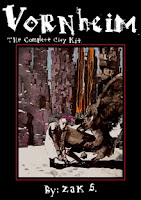
review: vornheim the complete city kit

Metric: Snakes.  For reasons that become apparent, snakes are associated with the erudite in Vornheim.
DISCLAIMER: Based on a PDF copy.  This book was designed as a physical product and may have  lost some elements in translation.  That said, printing some pages out got around that pretty quickly so...
Overall: 4.5 snakes (a setting and a workbook with some killer apps)
Those who want to speed up prep for their games need this.  Urban games will also benefit mightily from this book, though it's inspirations are applicable to megadungeons as well.  A willingness to play fast & loose with rules as written is assumed.  While the layout and text could be less cluttered, the design principles, cartography and volume of quality content is tough to argue with.  Vornheim deserves it's status as one of the best RPG products currently out.

Content:  5 snakes (brilliant cover charts and tables, strong flavourful setting and encounters)
Vornheim is original.  The first section mentions things off-hand because they may be relevant to your game. The oddities are odd and the presence of spells like vile hound, locations like the Immortal Zoo of Ping Feng and monsters like the flailceratops and plasmic ghoul make Vornheim atypical.  Superstitions and bizarre holidays are reminiscent of Gormenghast.  What makes this setting effective is how economic Zak is with the presence of the gods -  Vorn alone spawns a number of ceremonies and rituals, something that other campaigns may do well to emulate.  The baroque structures of Vornheim provide a good template for other cities and can be tweaked and modified by other GMs to fit their worlds.  Urbancrawl rules are a wonderful method for speedy generation of city streets and the floorplan shortcuts are quick ways to keep the game turning.  There are fistfuls of ideas in this book - some of which have been explored in Zak's blog. There are other sources credited as well, which is a nice touch.

Art & Layout: 4 snakes (awesome cartography, very clever cover charts, text chaotic useful)
Text layout is crabbed and claustrophobic, evocative but a bugger to speed-read, mercifully bolded text helps pick out the essentials.  The design elements and layout in other respects are very strong and Jim & Zak are to be commended.  Borders hold valuable chapter and page information which easily lets you move between sections.  PDF bookmarks work a treat and help navigation.  Artwork is rendered in Zak's style.  Some pieces have definition, the cover, the full page for House of the Medusa (p14) and flailceratops (p23) are cool.  The cartography is strong and Zak's style is intuitive, working in flat plane but arranged by floor (House of the Medusa), in orthographic perspective (Immortal Zoo of Ping Feng) reminiscent of a video game or vertical perspective (Library of Zorlac).  It's good stuff, using visual cues to ease dependence on keys.  Those used to pre-made floorplans may find this an issue.  That may not be the typical audience though...

In conclusion, this product stands alongside other excellent city sourcebooks.  Chaotic Useful is a relevant description.  Vornheim has fantastical elements that suit some campaigns perfectly.  New players may feel a bit intimidated but for those GMs who need a little fizz, this is a good present.  The support for 4th edition D&D was an unexpected bonus as well.  There are some bold ideas in here that have been excellently executed.  While some people may find it unpolished, the same argument could be made about prog rock vs. punk rock.  I may not know art, but I know what I like and I like this.  As a first album, it's good - the second one is the real test I hear...

Wednesday, 7 December 2011

damned city: oroguida

Oroguida is isolated from the Avernine by tar pits and quicksand banks fed by the Fiumorte.  The safest routes to Oroguida are by Occidua in Riccoferro and The Black Road in Animardente.  Boardwalks and stone piers keep Oroguida from sinking into brackish wetland that floods every autumn and winter.  Mud and water seeps through corrugated roads and boardwalks.  Dykes to limit flooding form canals by the boardwalks allowing barques and skiffs to move chattel.  The clink of coins and chains is ever-present.  Gold is the lifeblood of Oroguida.  It flows from a brisk slave trade as well as transfer of goods and individuals.  Status is conferred by visible gold or slaves.  Ostentatious wealth is preferred, vulgarity is expected.  Mercenaries in coin-riveted brigandine guard sedan chairs bearing bejewelled merchants with golden smiles.  By contrast, slaves bearing the sedan wear loincloths, manacles, whip scars and owner's brands.  Labourers may own a nose ring or gold medallion.  Artisans wear two or more rings with medallions or bangles.  A guard usually has half a dozen arm-bangles.  Some unwed women wear gold coins in head-dresses with charm bracelets. 

Near Occidua, a ghetto called Catenae grows around imported waterwheels.  Chainmakers forge chains using Riccoferran iron and scrap metal for anchors, shackles and weapons.  Mercenaries skilled in flails and spiked chains work out of Catenae, these _catenisti_ are the nearest thing to elite troops found in Oroguida.  There is a sizable drydock in Catenae that services the skiffs and barques plying canals transporting goods and people.  Tumulurbem stands between Catenae and the House of Hands.  Founded from an old village built on ancient ruins, explored by those seeking easy gold.  Flooding, unstable walls and degenerate mutants make this difficult.  There is gold but it's far from easy.  Pre-human gold idols found underneath are quickly smelted into gold ingots to avoid bloody reprisals.  Tumulurbem markets sell assorted supplies to explorers.  They also warn explorers balliffs will seize loot unless they are affiliated to a licensed business.

At Oroguida's heart is the House of Hands, a ten-towered structure resembling two grasping hands.  Here, the Aliquamante, a council of thirteen oligarchs preside.  Clad in hooded samite robes with gold masks of angry medusae, they are part syndicate, part priesthood.  They provide judgements and license trade in Oroguida for 10% of assets or income, whichever yields more.  The leader is The Wolf, a corpulent captain clad in gold-coin brigandine whose word is law.  Mercenary bailiffs enforce this by seizing goods and chattel.  The House of Hands watches over three great boardwalks with their attendant canals.  Slaves toil on windlasses to pump water out of the cellars.

Carnefossa deals in pigs, slaves and vice.  The branching southern canal links to the Fiumorte and sees traffic from Bacino and Perlanero.   The Wolf's bailliffs are particularly active in Carnefossa.  Nearer the House of Hands, the stink of swine, canal water and unwashed bodies fades under perfume.  Yet the stink never truly dies.  Further to the south, it grows to fill the nostrils.  Pig pens and cesspits are dug under boardwalks, sometimes used as prisons or slave holding pens.  Biting flies attract a variety of frogs, some poisonous.  Brothels, drug dens and wine houses riddle Carnefossa.  Streetwalkers work from the canal edge to alleyways within the shadow of the House of Hands.  Some use parasites and poisons to enhance their appearance, trading health and longevity for potential wealth.

Lacunero, a slum with a pall of brown smoke reaches east to tar pits bordering Animardente.  Near the House of Hands is the Black Alley where alchemists sell alchemist's fire, pigments and exotic metals.  Other streets near Black Alley Further along the great canal, smiths forge shining blades of stainless steel and potters sell enamelled clay.  Clay and stone is quarried  from flooding pits.  Furthest away, and close to the tar pits, residents mine bitumen for mortar, sealant and adhesive.  Watch towers keep vigil for caravans from Animardente.

Monday, 5 December 2011

dilany

No. Enc.: 1d4 (1d6)
Alignment: Neutral
Movement: 120' (40')
Armor Class: 7
Hit Dice: 2d8+2
Attacks: 1 (bite)
Damage: 1d4
Save: F1
Morale: 7
Hoard Class: VI

These 4' long squat marsupials resemble brindle-furred dog-faced rats with short tails.  The dilany is a fierce beast, when it successfully bites it locks it jaws and gnaws on it's victim doing 1d4 damage each round, clinging until either it or the victim dies.  They can be removed by the presence of open flame.  Their sense of smell is exceptional and they can track prey with it.  Dilany dig for worms and grubs but eat any meat they encounter.  A dilany nest is often foul-smelling and decorated with the gnawed bones of their prey. 

Saturday, 3 December 2011

inns & taverns: the rouge and glass

Gnomes enjoy beer in cellars. The Rouge and Glass is celebrated among gnomes, halflings and certain taller folk in the know.  Noise usually comes from it's doors and there is almost continuous activity.  Though some dislike it's gaudiness, it's popularity is evident.  The Rouge and Glass is tucked in a hill beneath a fortified tower manned by a platoon of crack gnomish crossbowmen.  Trouble is almost never a problem.  This has led to speculation that whoever owns the tower owns the inn.  Gnomes, dwarves, halflings and the wise know it's the other way round.  The sign is a steel mirror with gilt scrollwork and "The Rouge and Glass" painted in red.  This glows with foxfire as light fades.

From the outside, the inn is built within a hill with a tower atop it and a mirror affixed above a double door.  Through the double doors, an antechamber ends in a door between two crystal-studded pillars.  Light brought into this space causes the pillars to shimmer.  A lectern and stool are positioned to the right of the door.  During daylight, an old, extremely wizened gnome maid in somber fabrics and leathers alternates between pipe and hipflask to grant admission.  After sundown, the usual occupant is a gnome in spiked leather with steel wire woven into his beard.  He grants admissions but hassles those he dislikes.  Beyond this door is a long chamber, almost airy and spacious.  The layout is not unlike that of a ship, there are raised seating areas to the right and left of the door.  Pillars are roughly positioned where masts would be.  At the far end is a semi-circular ampitheatre with four tiers of gnome-sized seating.  The bar is on the left wall and decorated by various painted mirrors and crystal tiles.  Light flickers from an ostentatious candelabra of red and orange glowing crystals and copper wire.  This softens features as good firelight does.  Three closed doors to the left (cellar, landlord's office and a store room) and two to the right lead to privies.

A number of drinks can be purchased.  A brown ale, of wet sand colour and average taste is the safest bet. Many regulars prefer a hard pale cider or a dark ruby beetroot beer (dry with hints of earth and malt) to drink.  Connoissieurs may wish to take a glass of pomace (apple liqueur) or a slightly jaundiced genever.  Jugs of wine are also sold, red or white.  Neither are particularly appealing to any but drunks or those who cannot countenance ever drinking beer.  Food is not sold though on some cold nights hot meat pastries are offered to clients by staff.  These are greasy, yet substantial.  The meat defies simple identification and is of mixed origin smothered in thick onion gravy.

The staff here are mostly gnomes.  The landlord, Amlyn Hyssop, is rakishly handsome.  Twinking sapphire eyes and white-gold hair are sometimes complimented with a courtly suit, or flouted with a labourer's outfit and leather boots.  Comfortable and confident, Hyssop prefers to advance without drawing undue attention. His wolfhound, Reaver, is slavishly loyal.  The other staff are itinerant gnomes, equally balanced between male and female, all with ready smiles.  Practical jokes are regular occurences, resulting in beetroot beer fountains, inexplicable noises and coins attached to invisible thread.  The other staff are a troupe of dancers and musicians of various races.  These range from convivial line dancers to more exotic performances with veils and gaudily feathered fans.  One part Seven Brides for Seven Brothers, one part Moulin Rouge.

There is no accommodation.   Those seeking it are chased off.  Some patrons drag feet to tease favourite staff.  The invective unleashed often shows the height of gnomish creativity.  Those who don't take the hint will find themselves chased with brooms. Yet when Reaver growls all but the stupid drunks know that it's time to leave.  Reaver has been trained to take someone's hand between his jaws and gently lead them out.  Amlyn usually handles high-status troublemakers who inevitably visit, laden down with gold coin and disrespect.  They usually leave lighter of both.

Some humourless locals claim pickpockets work the Rouge.  This leads to 'raids' supported by staid clerics.  Amlyn and the bar staff tone down their ribaldry.  The regular clientele don't resulting in a brawl.  Needless to say, this provokes a crackdown.  The Rouge cloaks their more scandalous activities but word gets out - as it always does.  A large watch raid may meet stiff opposition from the crossbowmen and what appears to be a siege might attract attention...
Related Posts Plugin for WordPress, Blogger...

Greatest Hits